Average Reviews:

(More customer reviews)Are you looking to buy Joan Nathan's Jewish Holiday Cookbook? Here is the right place to find the great deals. we can offer discounts of up to 90% on Joan Nathan's Jewish Holiday Cookbook. Check out the link below:
>> Click Here to See Compare Prices and Get the Best Offers
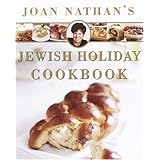
Joan Nathan's Jewish Holiday Cookbook Review`Joan Nathan's Jewish Holiday Cookbook' by the `Paula Wolfert' of Jewish cooking, Joan Nathan, is an updated composite of two of her earlier books, `The Jewish Holiday Baker' and `The Jewish Holiday Kitchen' on the 25th anniversary of the publication of the latter volume.I have reviewed only one other book of Jewish cooking, the big `New York Times' book of Jewish recipes and I can unequivocally say that as a first book on Jewish cooking, Nathan's book is a far, far superior starting point. The only reason you may want to buy the `New York Times' volume is if you are already so thoroughly knowledgeable about Jewish cuisine that all you want is a big book of good recipes.
I get the sense from this book that the fact that it deals only with `holiday' cooking does very little to limit the scope of the recipes, as it not only deals with the yearly holidays but also that cooking which is particular to the restrictions on observing the Sabbath.
I think it is no accident that in my survey of cookbooks so far, there are far more Jewish holiday cookbooks than there are for any other ethnic cuisine, as long as you don't count Christmas cookie cookbooks. In my somewhat limited experience with only English language cookbooks, I know of seven for Jewish holidays and only two for that great culinary dynamo, Italian cooking. And, Joan Nathan has written four of those titles!
Not only on holidays but also throughout their whole life, food and religion are more tightly intertwined for the Jews than with any other culture I know. The Christian use of unleavened bread and wine in their most important sacrament pales in comparison to the strictures of orthodox kashrut, the laws governing kosher, parve, and unclean foods and food combinations. I know the Muslims, being fellow Semites from the Middle Eastern deserts have similar strictures against pork, but I believe their rules are not nearly as pervasive.
The book provides seven (7) chapters on the major holidays, Rosh Hashanah, Sukkot, Hanukkah, Purim, Passover, and Shavuot plus a chapter on `The Minor Holidays' including Israeli Independence Day. The first and longest chapter covers the Sabbath which, in orthodox tradition, requires prohibits any cooking between sundown on Friday evening and sundown on Saturday evening. It's a bit more involved than that, in that what is really prohibited is lighting a flame during that time. That means stoves or ovens can be turned on before sundown to start slow cooking dishes, but no flame can be started in that 24-hour period.
For people who are simply interested in culinary folkways, the book is an excellent study in the intersection of culinary laws and the seasons. Not only were Jewish folk constrained by extreme poverty and the barrenness of winter, they were prohibited from access to the single most tasty and most easily preserved source of fat and protein, the pig. This was an even bigger hardship for the Jews of central Europe who lived outside the range of cheap olive oil, since it forbade them from using the very best animal fat for cooking. Even butter was proscribed in that one could not use butter together with any meat product, due to the kashrut prohibition against mixing meat and dairy. This more than explains the central role of chicken fat in the culinary traditions of Jewish cooks.
Ms. Nathan does not spend much time exploring the anthropological sources of kashrut, but she does an excellent job of showing us how it affected Jewish cuisine.
Not only does she give us dishes appropriate to the various holidays, we are also treated to menus which reflect differences in the Sephardic (Iberian) and Askanazy (Central European) traditions.
I find it eminently satisfying that the very first recipe is for challah bread, the braided egg bread typically made for Sabbath. I also find it very interesting that much more attention is paid to recipes for the American bialys than to the European bagel. I am also interested in the fact that Hanukkah is much more of a culinary and political holiday than it is a religious feast, since, according to an Orthodox Jewish friend, there are not even any standard rituals for the Synagogue for Hanukkah. This is hearsay, but Nathan does confirm that until the late Middle Ages, Hanukkah was a relatively unimportant date on the Jewish calendar.
I have yet to review some other Jewish holiday cookbooks, but for a good understanding of the traditions behind the culinary facts, this book is excellent.
Highly recommended.Joan Nathan's Jewish Holiday Cookbook Overview
Want to learn more information about Joan Nathan's Jewish Holiday Cookbook?
>> Click Here to See All Customer Reviews & Ratings Now

0 comments:
Post a Comment